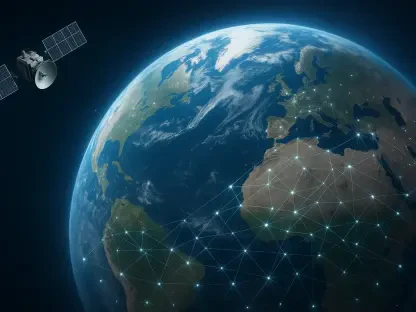

The rapid transition from terrestrial-only networks to integrated global systems is expected to drive the number of satellite IoT connections to nearly 198 million by 2035. This massive paradigm shift moves the industry away from a total reliance on localized terrestrial towers toward a truly global, integrated approach. Currently, in 2026, the landscape is evolving to eliminate the geographical dead zones that have historically hindered large-scale deployments in remote regions. This evolution is not primarily about increasing raw bandwidth but rather about ensuring that critical assets in sectors like offshore energy, industrial agriculture, and global maritime logistics remain reachable regardless of their distance from civilization. As these satellite-connected devices become a cornerstone of modern industry, the technology is shedding its reputation as a niche, expensive alternative for emergencies. Instead, it is being woven into the fabric of mainstream connectivity to bridge the gap where cellular signals fail, moving from a population-based model to a geography-based model that guarantees transmission across every square inch of the planet.
Emerging Market Trends: Sectoral Dominance in a Global Landscape
High-Volume Applications: The Shift Toward Ubiquitous Automotive Coverage
The automotive sector is poised to become the primary driver of satellite IoT growth, projected to account for over half of all connections by 2035. As vehicles evolve into autonomous, data-heavy machines, the demand for always-on connectivity becomes an operational necessity rather than a luxury feature. This shift ensures that trucks, cars, and delivery fleets remain connected while traversing remote corridors or during handoffs between terrestrial towers, effectively eliminating service interruptions in transit. For fleet operators, this means real-time telemetry is no longer interrupted by local topography or infrastructure gaps. Building on this foundation, sectors such as heavy transportation, cold-chain logistics, and smart city infrastructure are also fueling this expansion. These industries rely on mobile assets that frequently move through areas with inconsistent cellular coverage, making satellite integration a vital component for safety. What was once a high-cost solution for military use is rapidly transforming into a cost-effective standard for any business managing assets across vast distances.
Resource Management: Industrial Agriculture and Environmental Expansion
In addition to transportation, the industrial agriculture and environmental monitoring sectors are leveraging non-terrestrial networks to manage resources at an unprecedented scale. Farmers now utilize satellite-connected sensors to monitor soil moisture, livestock health, and equipment performance across thousands of acres of remote land where traditional cellular signals are unavailable. This capability allows for precise resource allocation, significantly reducing waste and improving crop yields in areas previously deemed digitally unreachable. Similarly, environmental organizations deploy these sensors to track deforestation or water quality in protected wilderness areas, providing critical data for global sustainability efforts. The democratization of space-based data means that even small-scale operations can now afford the connectivity required to participate in the global digital economy. As these applications proliferate, the sheer volume of connected devices is driving down hardware costs, further accelerating the integration of satellite technology into everyday industrial workflows that require consistent data reporting.
Technical Integration: Strategic Implementation and Operational Trade-offs
Hardware Evolution: Engineering Challenges for Device Manufacturers
For original equipment manufacturers, the path to nearly 200 million connections requires a complete rethink of hardware design and product lifecycles. Integrating satellite capabilities involves more than just software updates; it demands specialized antenna engineering and rigorous power management to handle energy-intensive transmissions. To reach mass-market adoption, the industry is moving toward integrated chipsets that can seamlessly toggle between terrestrial and non-terrestrial signals, significantly lowering the barrier to entry for device production. This hardware convergence allows for smaller form factors and extended battery life, which are critical for sensors deployed in harsh or inaccessible environments. Connectivity providers are simultaneously adapting to a growing demand for hybrid solutions that treat satellite links as just another roaming option. Modern enterprises expect a unified experience where satellite, cellular, and private networks are managed through a single dashboard. This shift forces providers to develop sophisticated roaming logic that masks technical complexity for the end user.
Tactical Roadmaps: Strategic Directions for Global Network Resilience
Stakeholders finalized the strategic roadmaps necessary to bridge the final gaps in global connectivity through 2035. Engineers addressed the critical challenges of latency and data payload constraints by implementing advanced compression algorithms and edge computing protocols that optimized every byte of transmitted information. Organizations adopted a hybrid approach that viewed satellite IoT as a powerful complement to existing 5G and LoRaWAN infrastructures, creating a resilient ecosystem capable of withstanding local outages. Leading firms invested in multi-constellation support to ensure that their assets remained visible regardless of specific orbital alignments. These decisions established the groundwork for a truly interconnected planet where geography no longer dictated the limits of digital access. Businesses prioritized the deployment of unified platforms that consolidated diverse data streams into actionable insights. By choosing to integrate satellite capabilities early, these leaders secured their operations against the limitations of traditional infrastructure and prepared for a more connected economy.